When I first started learning about RFID, I honestly thought it was pretty simple. There was the kind that lets you tap into a building with a key card, and then there was the kind used for highway toll systems and fast lane passes. That was honestly the full extent of my understanding.
As I kept learning more about RFID, I started seeing terms like LF, UHF, and NFC Everywhere. And at first, I honestly had no idea what separated them or why there were so many different types in the first place. Then someone casually mentioned LF, UHF, and NFC in the same conversation.
At first glance, they all sounded like slightly different versions of the same thing: wireless tags that scan stuff. But once I started diving into it, I realized they actually solve completely different problems. And honestly, the easiest way to understand RFID isn’t by memorizing frequencies or technical specs. It’s by understanding what each type is designed to do well.
That’s the explanation I wish someone had given me sooner.
Lets Take a Step Back: What Is RFID
RFID stands for Radio Frequency Identification. Which sounds complicated until you realize it’s basically just a way for objects to identify themselves wirelessly.
Instead of scanning a barcode with direct line of sight, RFID uses radio waves to communicate between a tag and a reader. That communication can happen from inches away or several feet away depending on the technology being used.
The part that confused me in the beginning was that different RFID frequencies behave very differently. Some are built for short range readability. Others are built for speed and scale. And some are designed specifically for interactions with smartphones.
That’s where LF, UHF, and NFC start to separate from each other.
LF RFID: Reliable and Intentional
LF stands for Low Frequency RFID, and it usually operates 125 kHz. That frequency helps determine how the RFID signal behaves, including things like read range, speed, and how well it performs around materials like metal or water.
This is the type of RFID commonly used for:
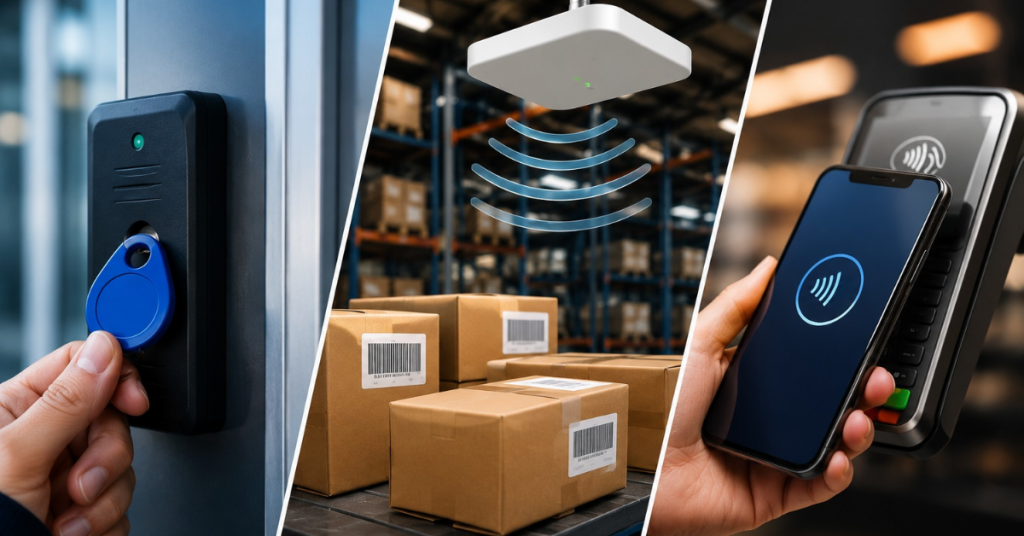
- Access control cards
- Animal tracking
- Older key fobs
- Industrial environments
What surprised me most about LF is that it’s not trying to be flashy. It’s not built for huge read ranges or rapid scanning. It’s built for reliability.
LF signals generally handle metal and moisture better than many RFID technologies, which makes them useful in harsher environments where consistency matters more than speed. The tradeoff is that LF systems usually have a very short read range. We are talking inches, not across the room.
But honestly, that’s part of the appeal.
If you’re opening a secure door or identifying a specific animal tag, you probably want that interaction to happen intentionally and up close. You don’t want accidental scans happening from several feet away.
That’s when LF started making more sense to me. It’s basically the careful and dependable version of RFID.
LF works especially well when:
- You only need to scan one item at a time
- Reliability matters more than speed
- The environment includes metal or moisture
- You want intentional close range interactions
UHF RFID: Built for Scale
Then there’s UHF RFID, which stands for Ultra High Frequency.
This is where RFID starts feeling futuristic.
UHF systems can read tags from much further away, sometimes more than 20 feet depending on the setup, and they can scan multiple tags incredibly fast. That’s why UHF dominates industries like:
- Retail
- Logistics
- Inventory management
- Supply chain tracking
- Race timing
- Asset tracking
This is the technology behind things like scanning an entire pallet instantly or locating inventory in real time inside a warehouse.
And this was probably the biggest mental shift form me:
UHF RFID is designed for scale.
Instead of carefully identifying one thing at a time, UHF is designed to identify lots of things quickly and efficiently. In many environments, a UHF reader can scan tags hundreds or even thousands of times per day second from long distances away. And interestingly, one of the biggest challenges with UHF isn’t always getting reads, it’s controlling them. In large operations like warehouses or dock doors, readers can sometimes pick up tags from unintended areas if the system isn’t carefully designed.
Of course, there’s a tradeoff there too.
UHF can be more sensitive to:
- Metal
- Liquids
- Environmental interference
Which means deployments often require more planning and testing. But when it’s implemented correctly, the efficiency gains can be massive.
That’s why UHF became such a huge part of modern supply chains and large-scale inventory systems.
Wait… So Where Does NFC Fit In?
This was honestly the part that confused me the most.
Because NFC feels completely different from the typical use of RFID.
But technically, NFC stands for Near Field Communication, and it’s actually a subset of HF RFID, which stands for High Frequency RFID.
NFC is designed for very short range communication, usually just a few centimeters away. And unlike UHF RFID, that short range is actually intentional.
NFC is commonly used for things like:
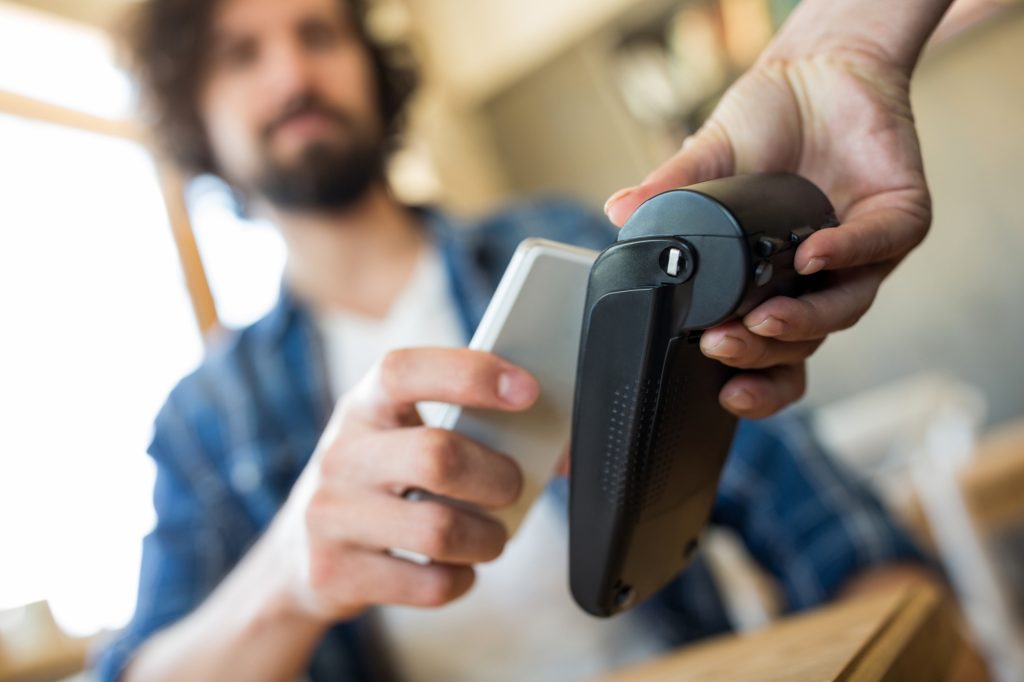
- Tap to pay
- Smartphone pairing
- Digital business cards
- Mobile authentication
Because the interaction range is so small, NFC works well for situations where you want the user to intentionally tap or hold something close to a reader. For example, when you unlock a door or make a payment, you probably don’t want your phone credential connecting from several feet awa
What makes NFC especially interesting is that smartphones can act both as:
- Readers
- Tags
That’s a huge reason NFC exploded in consumer technology while UHF became dominant in industrial and logistics environments.
The more I learned about it, the more NFC started feeling less like “another RFID type” and more like the consumer facing branch of RFID technology.
The Simplest Way I Learned to Think About It
Eventually, I stopped trying to memorize frequencies and technical charts. Instead, I started thinking about these technologies based on the problems they solve.
Here’s the simplest breakdown that helped everything click for me:
- LF RFID:
- Best At: Reliable close-range identification
- Typical Range: Inches
- UHF RFID:
- Best At: Fast large-scale tracking
- Typical Range: Several feet+
- NFC:
- Best At: Intentional phone-based interactions
- Typical Range: A few centimeters
- LF RFID:
What Problem Are You Trying to Solve?
At this point, you’re probably wondering: which RFID option is actually the best?
Honestly, that’s probably the wrong question.
The better question is: what problem are you trying to solve?
If you need:
- Long range inventory tracking across hundreds or thousands of items, UHF is the right answer
- Durable and reliable close-range identification, LF makes the most sense
- Users interacting directly with their phones through simple tap experiences, NFC is usually the best fit
Different tools for different jobs.
Understanding the Bigger Picture
The funny thing is, I originally thought RFID was basically just a “barcode technology but wireless.” Now I realize there’s an entire ecosystem behind it, and each type of RFID exists for a reason.
LF is built for reliability and controlled interactions. UHF is built for speed, scale, and visibility across large operations. NFC takes RFID into everyday consumer experiences by turning smartphones into a part of the system. And once I stopped thinking about RFID as one single technology, everything started clicking.
It’s really not about which frequency is “better”. It’s about choosing the right tool for the environment, the user experience, and the problem you’re trying to solve. That was the moment RFID stopped feeling overly technical to me and started feeling genuinely practical.