Most loyalty cards fail.
They sit in wallets unused. They get lost in drawers. They never see the follow-through, leaving customers disengaged and business owners wondering why their loyalty program isn’t driving customers to repeat purchases.
Here’s the truth: customers don’t ignore loyalty programs because they don’t care about the rewards. They ignore them because the value isn’t immediately clear, the design doesn’t inspire them, or signing up feel like another chore.
In today’s competitive market, you don’t just need a loyalty card, you need a design that instantly communicates value and makes joining feel like a no-brainer.
A well-designed loyalty card dramatically increases signups, boosts repeat purchases, and strengthens long-term customer retention.
The difference between a loyalty program that thrives and one that quietly dies often comes down to one thing: design.
Why Loyalty Card Designs Directly Impact Signups
A loyalty program is only effective if customers actually want to join.
And customers decide whether to sign up in seconds.
Your loyalty card design influences:
- How valuable the program feels
- How easy it seems to use
- Whether the reward feels achievable
- Whether the brand feels trustworthy
If the design looks confusing, cluttered, or overly complicated, customers assume the rewards program is complicated too. Simplicity increases trust. Clarity increases action.
If your goal is to increase loyalty card signups and improve customer retention, the design must be strategic, not decorative.
Because if customers don’t instantly see the benefit, nothing else matters.
6 Principles That Turn Loyalty Cards Into Revenue Drivers
1. Make the Rewards Impossible to Miss
The number one rule of loyalty card design: make the reward obvious.
Customers should understand the benefit within three seconds.
Examples of high-converting reward messaging:
- Buy 9, get the 10th free
- Earn 1 point for every $1 spent
- Spend $100, get $10 back
- Members save 15% every visit
Use large, bold typography for the reward. Avoid hiding it in small text. Do not assume consumers will “figure it out.”
The clearer the value proposition, the higher your loyalty program signup rate.
2. Keep the Loyalty Card Design Clean, Minimal, and On-Brand
Overdesigned loyalty cards reduce trust and clarity.
A clean loyalty cards design should include:
- 1-2 brand colors
- Clear typography
- Plenty of “white” space
- Simple layout
- No unnecessary fine print on the front
When customers see a simple design, they assume the reward program is simple. And simple programs get used.
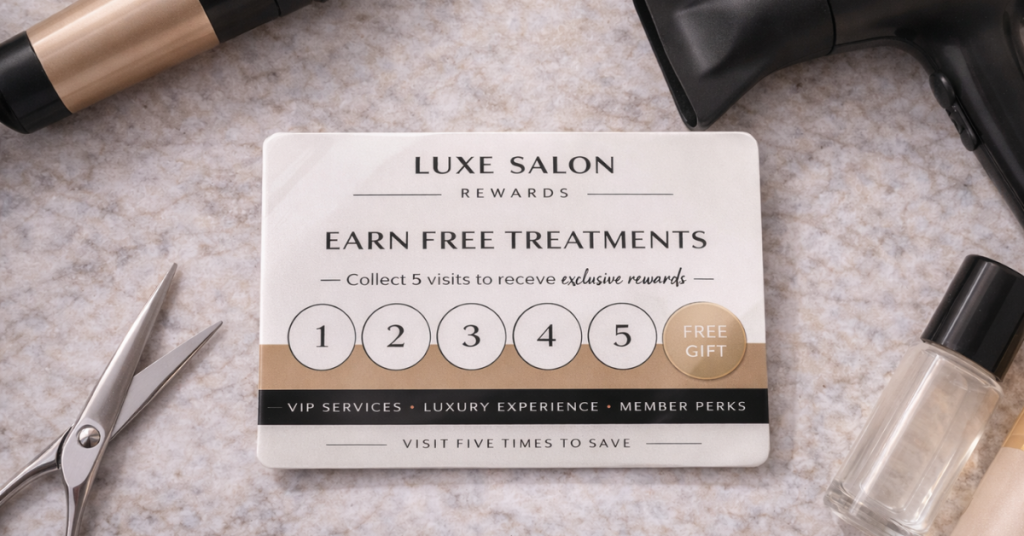
3. Use Visual Progress to Increase Completion Rates
People are psychologically motivated by visible progress.
This is why stamp cards work so well for coffee shops, restaurants, salons, and retail stores.
Consider adding:
- Stamp boxes
- Punch holes
- Reward trackers
- Digital progress bars
Even more powerful? Pre-fill the first one or two rewards spots.
This uses a behavioral principle called the endowed progress effect. People are more likely to complete something when they feel they have already started.
Visible progress increases engagement. Engagement increases retention.
4. Reduce Signup Friction
If signing up for your loyalty program feels like work, customers won’t do it.
Lengthy forms kill conversion rates.
To increase loyalty card signup:
- Collect minimal information
- Use QR codes for fast digital signup
- Allow instant in-store enrollment
- Avoid unnecessary steps
If you include a QR code on your loyalty card, label it clearly:
“Scan to join in 10 seconds”
The easier you make it, the more customers will enroll.
5. Offer an Immediate Incentive to Join
Delayed rewards reduce motivation.
If customers have to wait too long to benefit, many won’t sign up.
Boost loyalty program enrollment by offering:
- 10% off on signup
- A free item today
- Bonus points on the first purchase
- A complementary add-on
Immediate value creates instant excitement and increases signup conversation rates.
Make this incentive highly visible in your loyalty card designs and in-store signage.
6. Create a Sense of Exclusivity
Loyalty programs perform better when they feel exclusive.
Customers want to feel like insiders.
Use language such as:
- VIP Rewards
- Insider Perks
- Priority Access
- Members Only
Now Let’s Talk About What Most Businesses Overlook: The Physical Card Itself
Design isn’t just visual. It’s tactile.
The materials, finishes, and durability of your loyalty card directly impact how customers perceive your brand.
If your card feels flimsy, temporary, or cheap, customers subconsciously treat the program the same way.
If it feels durable and intentional, it reinforces trust and long-term value.
Gloss Finish:
- Brighter, more vibrant appearance
- Eye-caching under light
- Sleek & Bold
However, gloss can show fingerprints and glare under retail lighting
Matte Finish:
- Softer, more premium feel
- Reduced glare
- More subtle and sophisticated
- Easier to read under store lighting
For many retail environments, matte loyalty cards feel more refined and higher-end.
The right finish should catch your brand positioning.
Why Material Matters More Than You Think
Standard paper loyalty cards bend, tear, and wear down quickly.
When a loyalty card deteriorates, it sends a message, whether you intend it to or not. A flimsy, worn card can subconsciously lower the perceived value of your loyalty program and your brand.
That’s why material choice matters.
High-performance synthetic materials like Teslin offer a smarter alternative to traditional paper. Teslin loyalty cards are tear-resistant, durable, and designed to withstand daily handling without cracking or fading. They maintain print clarity over time and hold up in wallets, purses, and retail environments where moisture and friction are common.
Choosing a durable material ensures your card:
- Lasts longer in wallets
- Maintains crisp, professional print quality
- Withstands repeated use and handling
- Continues representing your brand the way it was intended
A loyalty program is built to drive long-term customer retention.
Your loyalty card should be built to last just as long.
Design a Loyalty Card That Customers Actually Want
If you want to increase loyalty card signups and improve customer retention, focus on this:
- Make the reward clear
- Make the process simple
- Make the progress visible
- Make joining easy
- Make the card feel valuable
When customers instantly understand what they get and how easy it is to earn it, signing up becomes the obvious choice.
A great loyalty card design doesn’t just sit in a wallet.
It drives repeat business, builds brand loyalty, and turns casual customers into long-term advocates.
Design with intention. Produce with quality. And let your loyalty program work as hard as you do.